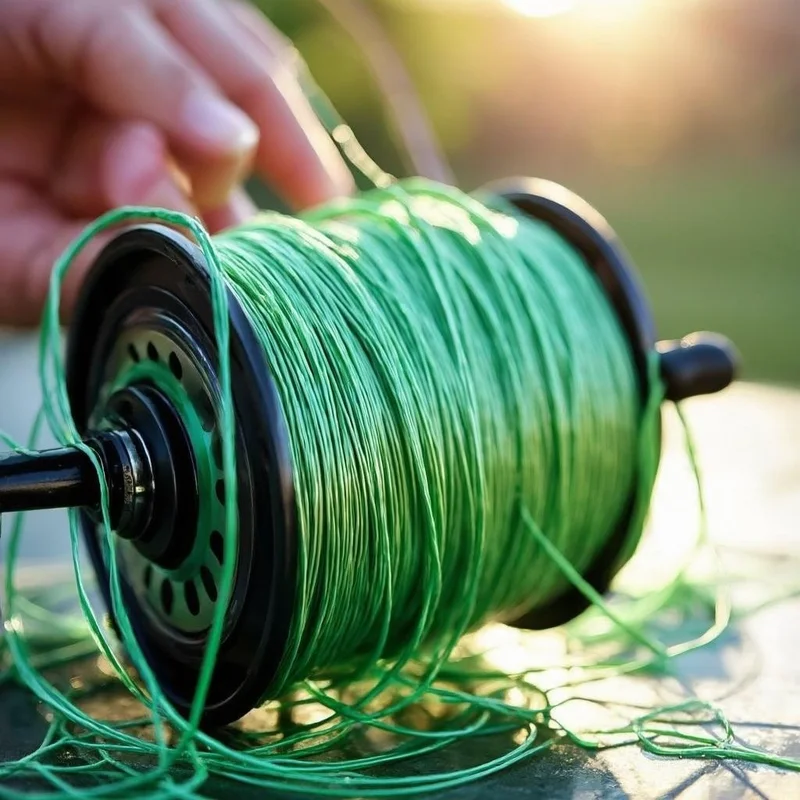
The label on a spool of fishing line tells you the pound test and the material. It does not tell you whether that spool was stored badly, manufactured off-spec, or left on a warehouse shelf too long.
For a few dollars and ten minutes, you can check the actual line in your hands before it costs you a fish.
This guide walks through three practical checks that work for mono, braid, and fluorocarbon. You do not need a lab. You need eyes, fingers, a ruler, and one knot.
Check 1: The Visual Pass
Hold the spool up to the light and run the line slowly through your fingers while looking at it closely. You are looking for four things:
- Uniform diameter. Line should look the same thickness along its length. Any visible fat or thin section is an off-spec batch, and that weak point is where the line will break.
- Colour consistency. A sudden colour shift or patchy fading on a new spool means the dye or coating process failed. It is cosmetic, but it often predicts other process problems.
- Fuzz or nicks. Run the line against a dark background. Any fuzz on mono, or broken filaments on braid, means the line has been abraded, either in manufacturing or in storage.
- Coil memory check. Pull out half a metre and let it hang. If it springs back into tight coils immediately, the line has high memory, which means more wind knots and line twist on the water.
If the line fails any of these visual checks, you have saved yourself the trouble of testing it further. Return it and try another brand or batch.
Check 2: The Touch Test
Feel matters more than most anglers admit. Run a metre of line between your thumb and forefinger with light pressure, several times, along the same section:
- Softness. Good mono should feel supple, not stiff and wiry. Stiff line casts poorly and holds memory. Braid should feel smooth and round; a flat or rough braid is low quality or worn.
- Rough spots. Any section that catches or feels gritty is damaged. A rough section will create friction at the guides and break early.
- Recovery. Bend the line around your finger into a loop and release. Quality line returns to a relaxed state quickly. Line that stays kinked has permanent deformation, which means casting problems from the first cast.
The touch test is subjective, but after you compare three brands side by side you will quickly feel the difference between a premium batch and a budget batch. That comparison is exactly what to do before committing to a bulk purchase for the season.
Check 3: The Knot and Pull Test
This is the check that predicts real performance. Tie the knot you actually use on the water, such as a clinch or palomar, and tie the other end to a fixed point. Pull steadily, not with a jerk.
The line should break well above the label rating, and it should break at the knot or in the middle, not suddenly at a specific damaged spot.
Two things to watch:
- Where it breaks. If the line consistently breaks at the same point along its length, you have found a defect in that section. If it breaks at the knot, your knot needs work or the line is very stiff, which reduces knot strength.
- How it breaks. A clean snap is normal. A line that shreds or parts with visible damage at the break point was already compromised before you pulled.
For extra confidence, measure the line diameter with a digital caliper and compare it to the published spec.
Line that is noticeably thicker than rated for its pound test is either mislabelled or a different material mix, both of which affect your reel capacity and casting.
What the Results Mean
The three checks map to three outcomes:
- Pass everything: the spool is good. Store it correctly and it will perform to spec. The storage guide explains how to keep line fresh.
- Fail visual or touch: the batch is compromised. If you bought it recently, return it. If it is an old spool, this is the answer to the question of how long fishing line lasts.
- Fail the knot test: retest with a different knot before blaming the line. Some lines simply need a different knot to reach their rated strength.
Regular inspection also tells you when to replace the line on your own reels. The signs here are the same signs you look for in a new spool: fuzz, memory, and rough spots. When those appear, it is time to restring.
The replacement guide covers the full decision process.
FAQ
How can I tell if fishing line is bad without testing it?
Look for visible fuzz, uneven diameter, stiff coils, or rough spots when running the line through your fingers. Any of these is a strong sign the line is compromised, even before you tie a knot.
Does the diameter of fishing line matter for quality?
Yes. Line that is thicker or thinner than its label suggests is off-spec. It affects reel capacity, casting distance, and how the line behaves underwater. A digital caliper gives you a quick check.
Why does my line break at the knot?
Knot breaks usually come from stiff line, a damaged section near the tag end, or a knot that is not suited to the line type. Retest with a different knot, and inspect the first few metres of line for nicks.
How often should I check my line?
Before the season and after any trip where the line was heavily used or exposed to sun and salt. A five-minute check is cheaper than losing a fish to a weak section.
Can fishing line go bad in storage?
Yes. Heat, UV light, and chemicals degrade line over time. Old line loses strength and gains memory. If a stored spool fails the visual check, replace it even if it has never been used.