Table of Contents
- 51. Why is there a gap left on the safety lead clip even when the tail rubber is tightened?
- 52. What should I do if the lead flies off the clip during a heavy cast?
- 53. What is the purpose of the quick-change swivel?
- 54. Why does the flat pear lead (method feeder) on a short-hooklink rig have a bait frame?
- 55. What is the raised bump in the center of the molded bait for?
- 56. Why doesn't the labeled weight on the method feeder match its actual weight?
- 57. What is the ideal groundbait mix for a method feeder? What should I watch out for when mixing?
- 58. How do I mount the bait on the rig?
- 59. How many types of Euro carp baits are there, and how do I choose?
- 60. What is the rubber sleeve at the back of the hook for?
- 61. Which part of the hook is best for positioning the boilie?
- 62. How much buoyancy should the hooklink have, and how do I adjust it?
- 63. What is the optimal state for a hooklink underwater?
- 64. What is the purpose of the swinger (bobbin/hanger)?
- 65. What are the different types of swingers?
- 66. How is swinger tension determined?
- 67. What are the pros and cons of automatic tensioning swingers?
- 68. Where is the power switch on photosensitive (light-sensing) swingers?
- 69. How should I adjust the tightness of the swinger's line clip?
- 70. How many types of tents (bivvies) are used in Euro carp fishing?
- 71. Why are bedchair bivvies so popular?
- 72. Do these tents have lights that sync with the bite alarms?
- 73. What is the purpose of a carp cradle (unhooking mat)?
- 74. Why doesn't the weighing tripod have four legs?
- 75. What is the recommended weight capacity for the hanging scale?
- 76. How long should a weigh sling (retention sling) be?
- 77. Why are Euro carp landing nets always triangular?
- 78. Is the fine, thin mesh on triangular nets durable enough?
- 79. What is the correct way to use a triangular landing net?
- 80. How do I coordinate the netting process with the fish's movements?
- 81. What type of folding table is best?
- 82. Are there dedicated rod holdalls for Euro carp fishing?
- 83. What fits inside the matching carryall bag?
- 84. What type of bait boat is best?
- 85. What are the advantages of the bait boat you use?
- 86. Why do Euro carp anglers prefer using bait boats?
- 87. Why should I create concentrated "spot baits"? How do I do it?
- 88. What shape of groundbait is best?
- 89. Why is there a large positioning error when using a bait boat?
- 90. Share some tips on baiting up.
- 91. What does the "three-point line" concept mean in casting, and how do I do it?
- 92. How do I master the release point when casting a multi-piece carp rod?
- 93. Everyone knows smooth, even power is required for an accurate cast. How do I achieve it?
- 94. Why is casting controlled by "intention" the mark of a true expert?
- 95. What should I consider when buying a Euro carp fishing setup?
- 96. What is "line twist" (internal stress) on a fishing line?
- 97. What is the cure for line twist?
- 98. Why shouldn't I open the bail arm when dropping lines with a bait boat?
- 99. Why must I open the bail arm exactly when the bait boat drops the rig at the spot?
- 100. How do I fix severe line twist and tangles once they happen?
📖 Also read: Part 1: The Complete 50-Question Guide (Q1–Q50) , Origins, rods, rod pods, reels, bite alarms, receivers, and rig fundamentals.
51. Why is there a gap left on the safety lead clip even when the tail rubber is tightened?
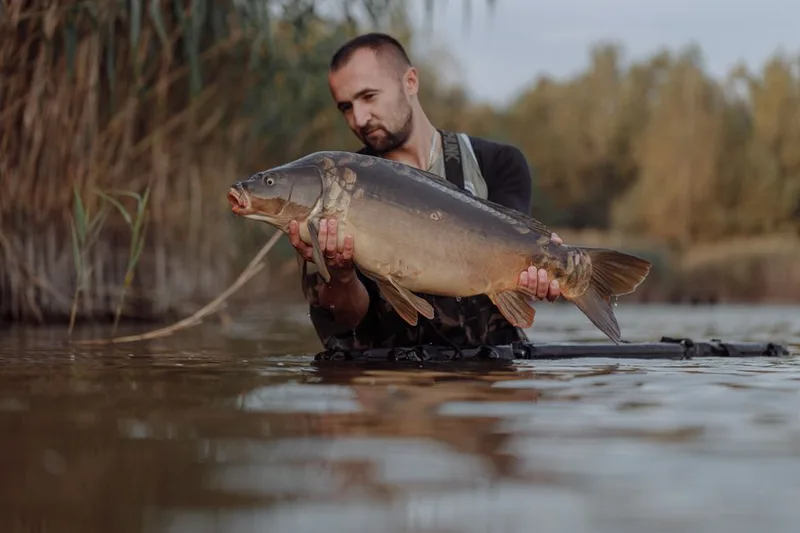
This design is rooted in the European catch-and-release conservation philosophy. Europeans rarely eat freshwater fish, making carp primarily a target for recreational and competitive fishing.
Because the underwater environment is complex and leads can easily snag on rocks or submerged branches, a hooked fish would have a very small range of motion and would likely die if tethered for too long.
To solve this, an escape mechanism is designed: the intense struggle of a hooked fish creates enough force to pull off the tail rubber at the back of the clip, allowing the fish to break free through the gap.
This gap is also used for changing leads.
52. What should I do if the lead flies off the clip during a heavy cast?
During casting, although the tail rubber secures the line tube and the clip together, a heavy cast can cause the lead to dislodge due to a wet rig, aged and hardened rubber, or an overly heavy lead.
There are three solutions: 1) Wrap some fine fishing line around the gap to seal it tightly before securing the tail rubber; 2) If the tail rubber has lost its elasticity over time, simply replace it with a new one; 3) Slightly reduce the weight of the lead to decrease the explosive force during the cast.
53. What is the purpose of the quick-change swivel?
The quick-change swivel serves two purposes.
First, during a cast, the lead is at the very front and naturally spins on its axis, causing abnormal aerodynamic drag and potentially snapping the base of the lead clip.
The swivel counteracts this twisting force. Second, it allows for quick and easy lead changes depending on different requirements.
54. Why does the flat pear lead (method feeder) on a short-hooklink rig have a bait frame?
The method feeder, or flat pear lead, is currently very popular among anglers for two reasons.
First, its flat design creates upward lift in the water, reducing drag and preventing it from burying into the bottom. Second, the teardrop-shaped lead features a ribbed frame for holding groundbait (chum).
Once packed, the bait follows the lead directly to the spot. Since groundbait is loose and hard to mold, yet needs to withstand forceful distance casting, the ribbed frame provides the perfect support.
55. What is the raised bump in the center of the molded bait for?
The method feeder rig is simple and practical: fill the bait mold with groundbait, press the feeder into it, and pop it out.
The resulting bait lump is uniform in shape, size, and weight, ensuring casting accuracy. The molded bait has a small raised bump on the top, this is where you place your hook and bait.
By pressing the hook into the bait directly below the bump, the hookbait stays exposed on the outside. This prevents the hook from tangling with the mainline during flight.
56. Why doesn't the labeled weight on the method feeder match its actual weight?
The labeled weight represents the total combined weight of the flat lead plus the groundbait, usually factoring in an extra 8 to 10 grams for the bait. This labeling makes it easier to calculate capacity and master your casting distance.
57. What is the ideal groundbait mix for a method feeder? What should I watch out for when mixing?
Groundbait is a crucial component of the method feeder rig and directly determines your success. The bait should have a strong, meaty/fishy scent and a slow breakdown time.
I use a ratio of 2 parts Yezhan Blue Crucian (wild-field bait), 1 part Snail Carp, or equal parts of commercial baits like Tianxia Wushuang, Huangshi, and Carp Flag, using flour to adjust the stickiness.
Both wheat gluten and flour are sticky, but their density changes differently in water. Flour is more durable in water, which synergizes well with the slow-breakdown characteristics of Euro-style boilies.
58. How do I mount the bait on the rig?
At the base of the hook, there is a small loop of line (the hair) passing through a tiny rubber band, usually about 2.5 cm long.
If using a pop-up boilie, push a baiting needle through its center, catch the hair loop, pull it through the bait by about 1 cm, insert a boilie stop (hair stop) into the loop, and pull the bait tight against it.
59. How many types of Euro carp baits are there, and how do I choose?
Boilies are the primary choice.
As Euro-style carp fishing has gained popularity, various baits differing in buoyancy, color, diameter, ingredients, breakdown rates, and derivatives have been developed based on different fish species' habits, swimming depths, feeding behaviors, water environments, and bottom topography.
60. What is the rubber sleeve at the back of the hook for?
Both the "hair rig" and the "method feeder rig" feature a small 3mm rubber ring/sleeve (line aligner/shrink tube) that pins the hair to the hook shank. Many anglers overlook it because it's so small.
First, in Euro carp fishing, where the bait is separated from the hook, sliding this small rubber sleeve up or down holds the boilie in the exact desired position on the back of the hook.
Second, by twisting and tightening, it wraps the excess hair line tightly around the shank, keeping the bait securely close to the hook.
61. Which part of the hook is best for positioning the boilie?
This depends on the hook's height off the bottom based on your rig: For rigs sitting slightly off the bottom, position the boilie near the front of the shank.
This keeps the hook point tilted downward in a concealed posture, ideal for targeting large carp or black carp.
When fishing for grass carp with the hook 20 cm off the bottom, the bait should be placed at the top of the hook's bend. Different fish have significantly different feeding habits.
The rule of thumb is: the lower the bait is to the bottom, the further the boilie is from the hook point; the higher off the bottom, the closer the boilie is to the hook point.
62. How much buoyancy should the hooklink have, and how do I adjust it?
The buoyancy at the rig's bottom comes from two sources: the pop-up boilie itself and the EVA foam material.
The common requirement is that they must have enough sustained buoyancy to lift the combined weight of the hook and the boilie for long periods.
63. What is the optimal state for a hooklink underwater?
In large bodies of water, the water column constantly moves due to weather and topographical changes, creating currents. The hooklink, along with the floating hook and boilie, sways with the current.
The more natural this sway is, the more it lowers the fish's guard.
Therefore, the hooklink shouldn't be pulled completely taut vertically by excessive buoyancy, which makes the movement look stiff and unnatural compared to the surroundings.
Allowing a slight bit of slack in the hooklink increases its range of motion with the current, making it smooth, subtle, and harmonious with the underwater environment. This is the optimal state.
64. What is the purpose of the swinger (bobbin/hanger)?
The swinger, commonly known as a tensioner, serves the following main purposes:
65. What are the different types of swingers?
While they all serve the same core purpose, structural differences exist based on environmental conditions and personal preference. Connection methods include soft chains, stiff arms, bike chains, fixed or adjustable tension, and single-head designs.
66. How is swinger tension determined?
Tension is generated primarily by the swinger's own weight and structural design. The distance to the spot and the line diameter are critical factors.
Long-distance fishing is heavily affected by currents and weather; thicker lines inherently increase the weight and add internal tension to the line itself.
Without sufficient tension from the swinger, the line won't stay straight, compromising sensitivity. For long-distance fishing, you must use heavier swingers. For closer ranges, lighter swingers work fine.
The tension just needs to meet two criteria: appropriate weight and matching the drag force of your reel.
67. What are the pros and cons of automatic tensioning swingers?
Automatic tensioners are relatively new products that combine electronics and mechanics. They are convenient and adjust tension automatically. However, they are mechanically complex, bulky, and expensive. I believe there's no need to over-automate fishing.
If someone invents a robot to fish for us, where is our interaction with nature? Where is the thrill and excitement of hooking a fish?
The mindset of finding peace and cultivating oneself would be completely lost.
68. Where is the power switch on photosensitive (light-sensing) swingers?
Light-sensing swingers feature a gravity-activated automatic switch paired with a photosensitive component. Powered by two LR44 button batteries, the structure is simple and offers an extremely convenient "off by day, on by night" display function.
The power switch is located inside the battery compartment; simply twist the knurled bottom cap a half-turn counterclockwise to turn it off.
Make sure to do this when you finish fishing, or the swinger will automatically light up when stored in the dark until the batteries are dead.
69. How should I adjust the tightness of the swinger's line clip?
The ball-style line clip shouldn't be too tight or too loose.
70. How many types of tents (bivvies) are used in Euro carp fishing?
There are roughly three types:
71. Why are bedchair bivvies so popular?
Being elevated off the ground protects you from dampness and cold. The tent cover acts as a shield against wind and rain, providing a private sanctuary.
Features include: six adjustable, telescoping legs to ensure the bed is level on uneven terrain; an ergonomic mattress for comfortable sleep; a built-in raised headrest and storage pockets for phones; a wipe-clean, breathable foot section so you don't have to remove your shoes; double-layer zip doors (solid and mesh) on both sides; and overhead hooks for synchronized lights.
Adding an overwrap provides extra insulation and gear storage.
Packing up is incredibly fast: remove the two titanium-aluminum support bars, flatten the tent, poles, and sleeping bag onto the tri-fold bed, fold in the legs, stuff it all into the carry bag, and you're done.
72. Do these tents have lights that sync with the bite alarms?
Several manufacturers produce these. These synchronized bivvy lights receive a signal from the bite alarm and illuminate immediately, automatically turning off after 5 minutes.
This completely solves the issue of fumbling for clothes and shoes after being woken up by a run.
73. What is the purpose of a carp cradle (unhooking mat)?
To prevent the fish from getting injured by being placed directly on the ground, a rectangular mat with raised sides and a lowered center is used.
You pour some water into the recess to keep it wet. The netted fish is placed directly onto the mat for unhooking.
This minimizes the fish's violent thrashing caused by discomfort and prepares it for the next step: weighing.
74. Why doesn't the weighing tripod have four legs?
A tripod with three legs spaced 120° apart easily finds its center of gravity and balances on uneven ground, enhancing stability. It also makes getting the weigh sling in and out much easier.
Reducing the time the fish is out of the water is a crucial fish-care practice.
75. What is the recommended weight capacity for the hanging scale?
A scale with a range of 0 to 30 kg is generally sufficient.
Need the Right Line for Long-Distance Carp Fishing?
Bait boats, heavy rigs, 200m+ casts , your line is the weakest link. LineCalc Pro finds the perfect match.
Try LineCalc Pro →76. How long should a weigh sling (retention sling) be?
A weigh sling is basically a piece of mesh fabric suspended between two aluminum poles with two carrying handles. It acts as a tool for weighing and safely releasing fish.
Once weighed in the shortest time possible, two guys grab the large handles and carry the fish back to the water, a wonderful memory of excitement and joy.
77. Why are Euro carp landing nets always triangular?
Triangular landing nets are designed based on fish morphology and angling habits.
A straight front edge allows the net to open fully and glide flush along the bottom, making it much easier to scoop the fish.
This shape is far superior to round nets, especially for large freshwater fish.
The depth of the net is equal to the width of the opening, which provides comfort for the fish once netted and reduces aggressive thrashing out of the water.
The triangular net is also highly compact: simply press the locking button to fold it, wrap the mesh around it, and it fits easily into the side pocket of your rod holdall.
78. Is the fine, thin mesh on triangular nets durable enough?
The mesh is mostly made of woven polyester threads, and the outer layer is coated with resin to reinforce the holes.
Once submerged, the smooth surface forms a water film, making it easier for the fish to slide in.
The fine mesh distributes the weight of the fish evenly, so you don't need to worry about it tearing.
79. What is the correct way to use a triangular landing net?
Because the mesh is fine and deep, it can feel cumbersome. When netting, use your finger to press the leading corner of the net mesh against the spreader block (where the arms meet the pole).
This reduces water drag and prevents the mesh from snagging the bottom. Once the fish is over the net, release your finger so the mesh drops naturally.
Lift and scoop in one fluid motion, then place the fish onto the unhooking mat.
80. How do I coordinate the netting process with the fish's movements?
Since the mesh is fine and water resistance is high, the net isn't very agile. This requires perfect coordination between the angler fighting the fish and the person netting it.
81. What type of folding table is best?
Any folding table works, as long as it's the same height as your fishing chair armrests, making it easy to grab items.
82. Are there dedicated rod holdalls for Euro carp fishing?
Yes. A standard long rod bag is 125 cm, but a 3-piece 3.6m put-over carp rod collapses to 128 cm, meaning it won't fit by just 3 cm.
Dedicated carp rod holdalls are exactly 130 cm long and use a modular design.
Besides holding four fully set-up rods, they can also accommodate four 6000-size baitrunner reels, a 4-rod buzzer bar, a triangular landing net, and more.
One bag holds your entire setup, keeping everything neat and convenient for use and storage.
83. What fits inside the matching carryall bag?
The carryall is a versatile bag. The zippered compartment in the top lid can store bite alarms, remote controls, and swingers. The side and end pockets can hold rigs, leads, accessories, tackle boxes, and stringers.
The main compartment has ample space for larger items like mixing bowls, boilies, groundbait, throwing sticks, and marker floats.
84. What type of bait boat is best?
A bait boat with the following specs is ideal: speed over 60 meters/minute; GPS autopilot/positioning; integrated sonar/fish finder; batteries rated 20Ah or higher; hopper capacity of over 4 kg; a hook-release mechanism; a hard-shell rolling carry case; and an integrated remote control.
85. What are the advantages of the bait boat you use?
I use a top-spec Chuantian brand bait boat. Besides standard features, I really love these three things:
86. Why do Euro carp anglers prefer using bait boats?
Creating a good baited area (the "swim" or "spot") is critical in reservoir fishing; Euro carp fishing is no exception. Without it, you'll go home empty-handed.
87. Why should I create concentrated "spot baits"? How do I do it?
Concentrated spot baiting keeps the feed in a tight area, allowing the fish to quickly find the hookbait. This is highly effective for drawing fish in, especially in large waters with low fish density.
It uses significantly less bait than widespread carpet baiting. If you use modern, scientifically formulated organic baits, you need less volume but get higher efficiency, reducing your bait costs.
Because the bait is concentrated, it encourages competitive feeding among schools of fish.
When fishing slightly off the bottom with a pop-up boilie, which stands out from the rest of the feed, it strongly triggers the fish's feeding impulse.
Baiting a spot quietly avoids spooking the fish in a large lake, keeping the spot active for a long time.
88. What shape of groundbait is best?
As long as it meets four criteria, color, shape, scent, and cost-effectiveness, it works. Commercial boilies or 5 cm cubes of pressed peanut, rapeseed, or soybean cake are optimal.
If using corn, it’s best to boil it until the kernels slightly burst, giving off a strong natural scent, which also speeds up sinking and makes the drop zone easier to control.
If using fresh sweetcorn, mix in some fermented "Lao Tan" (old jar) corn and let it ferment for a day before use for excellent results.
Note: When bagging fermented corn, squeeze out most of the air to prevent the bag from bursting as gases build up.
89. Why is there a large positioning error when using a bait boat?
Bait boat positioning relies primarily on Beidou or GPS satellite networks. When buying a boat, check if it has a dual-module receiver.
Having both Beidou and GPS is best, as the denser satellite coverage provides higher correction values and pinpoint accuracy.
90. Share some tips on baiting up.
Let me share an experience. In the UK, freshwater venues are relatively small; a 30-50 acre bay is considered a major carp water. Fishing on private land without permission is illegal.
In such a small area, where a third is covered in shallow 20cm reeds, there might only be one or two viable "swims" (pegs).
The casting distance is only about 40 meters, but the anglers are incredibly precise, landing within a 1-meter radius every time, back in the days when PVA bags were used.
I asked my British friend Brian why.
He said: 1) Concentrated baiting creates competitive feeding, increasing the hook-up rate. 2) The hookbaits are placed just in front, behind, or to the sides of the baited patch.
Because the local carp are large, battle-hardened veterans, they are very cautious. They won't rush into the center to feed; instead, they circle the perimeter first to check for danger.
Placing the hookbait slightly off the main patch intercepts them on this "outer patrol route."
91. What does the "three-point line" concept mean in casting, and how do I do it?
In geometry, two points make a line. So where is the third point? In fishing, the third point is the exact spot where your bait lands on that straight line.
92. How do I master the release point when casting a multi-piece carp rod?
Some anglers tell me their casting is inconsistent. There's only one reason: an inaccurate release point. Mastering this is a skill.
Release too early, and the lead goes high but not far; release too late, and it violently recoils downward, potentially injuring someone.
Missing the spot entirely means you scatter the bait, failing to hold the fish and potentially ruining the swim.
93. Everyone knows smooth, even power is required for an accurate cast. How do I achieve it?
Inaccurate casting is a major hurdle, even a source of dread, for many anglers. Here is how to lock down your accuracy:
94. Why is casting controlled by "intention" the mark of a true expert?
Accurate casting is the fundamental skill of Euro carp fishing. A chaotic, scattered baiting approach won't build a proper spot and severely hurts your catch rate.
I urge anglers to calm down and practice this basic skill, otherwise, you'll feel incredibly embarrassed at venues or tournaments where bait boats aren't allowed.
95. What should I consider when buying a Euro carp fishing setup?
Euro carp gear has countless variations: rods vary in length and stiffness; reels come in large and small sizes; alarms differ in range and features; lines vary in thickness and suppleness; and rigs differ in weight.
It’s a dizzying array. To choose a setup that feels right for you, consider three primary factors: Personality, Environment, and Budget.
96. What is "line twist" (internal stress) on a fishing line?
Line twist is a rotational axial force that builds up radially along the fishing line.
While this is a necessary manufacturing technique for making ropes and nets, it's a massive headache in fishing line.
(Poor spooling technique can introduce twist before you even cast , learn how to spool without line twist.) It always seems to strike at the worst possible moment, right when you are netting a fish.
During the fight — the line is under tension, keeping the twist suppressed. However, netting requires you to give the fish some slack.
The moment you drop the tension — the internal twist violently releases, instantly tangling the line into a massive birds-nest (like twisted dough). If the fish is safely in the net, fine.
But if you miss the net and the fish makes a sudden run, you can't release line, and you can't reel in. It is an incredibly frustrating and helpless situation.
97. What is the cure for line twist?
Eliminating and managing line twist relies heavily on a tiny rig component: the high-speed anti-twist swivel.
It connects your mainline to your rig, but its critical function is utilizing its reverse-spin capability to neutralize the twist built up in the line.
When the twist tries to release, the swivel rapidly spins in the opposite direction, bleeding off the rotational force.
This minimizes the clustering effect, at least keeping the twisted loops large enough that they don't tightly knot over themselves, which also helps you untangle it later.
98. Why shouldn't I open the bail arm when dropping lines with a bait boat?
If you open the bail arm on a spinning reel to let the boat pull the line, the line peels off the spool in coils.
If one coil is 16 cm long, dropping a rig 100 meters away means you've put 625 twists into the line. A massive tangle is guaranteed. So, what's the solution?
99. Why must I open the bail arm exactly when the bait boat drops the rig at the spot?
This is a critical detail. When the rig is transported to the spot and dropped, you must immediately open the bail arm.
If you don't, as the heavy rig sinks to the bottom, the tension from the mainline (still running through the baitrunner drag) will pull the rig back toward you in an arc, causing it to land far off the baited spot.
This is especially severe in deep water, the deeper it is, the worse the deviation. This is likely the reason you can sit for hours over a baited spot without a single bite.
100. How do I fix severe line twist and tangles once they happen?
Repeated casting, reeling, and bait boat drops will inevitably cause line twist to accumulate. It manifests as severe tangles, which ruin the fishing experience and destroy the line. Try these three methods to fix it:
📖 Also read: Part 1: The Complete 50-Question Guide (Q1–Q50)
Sources & Industry References
- International Game Fish Association (IGFA) , Official world record authority and fishing line standards reference
- Wired2Fish , Independent fishing gear reviews and line testing data
- Tackle Warehouse , Comprehensive fishing line specs, diameter charts, and user reviews
Found This Guide Helpful?
Check out LineCalc Pro , our free fishing line calculator that recommends the perfect line for your exact setup. No guessing, no wasted money.
Try LineCalc Pro →Frequently Asked Questions
Who is this guide for?
Anglers looking to make informed decisions about fishing line selection , from beginners to experienced fishermen who want to understand the technical details behind line performance.
What's the most common mistake anglers make?
Choosing line based on price alone, or using the same line for every situation. Line diameter, material, and pound test should match your target species, water conditions, and fishing technique.
How often should I replace my fishing line?
Monofilament: every season or after 8-12 trips. Fluorocarbon: every 2 seasons. Braided line: can last 2-3 seasons if properly maintained. Replace immediately if you see fraying, discoloration, or memory coils.
Braid vs Mono vs Fluorocarbon , which should I pick?
Braid for sensitivity, casting distance, and heavy cover. Mono for topwater lures, stretch forgiveness, and budget. Fluorocarbon for clear water, leader material, and abrasion resistance. Most anglers use a combination.
What pound test line should I use?
Match to your target species: 4-8lb for panfish, 8-12lb for bass, 15-30lb for catfish/striper, 30-65lb for musky/saltwater. Check your rod's line rating , it's printed on the blank for a reason.
What should beginners check before buying line?
1) Match line weight to your rod rating. 2) For spinning reels, stick to 8-12lb to avoid wind knots. 3) Don't overspend on your first spool , $8-15 mono is perfectly fine to learn on.