Table of Contents
I was 14 years old, standing in the fishing aisle of a Kmart with $11 in birthday money, staring at a wall of spools that all looked the same. Trilene. Stren. SpiderWire.
Numbers I didn't understand , 4, 6, 8, 10, 12. I grabbed the 20-pound because bigger meant stronger, and stronger meant better. Right?
I didn't catch a single fish that summer. Not one.
It took me another two seasons to figure out why. The line was half the diameter of a drinking straw.
Every fish in the clear water of my local pond could see it from six feet away. They'd follow my lure, get close, then turn away at the last second. I blamed the weather.
I blamed the bait. I blamed everything but that spool of 20-pound monofilament.
Here's what I know now, after 20 years of spooling and respooling reels for bass, trout, catfish, walleye, and panfish: choosing fishing line isn't complicated. The internet has made it feel that way.
You don't need to understand molecular polymer chains or refractive indices. You need to answer three questions. That's it.
This guide is the one I wish someone had handed me at 14. No jargon. No upsells. Three questions, two minutes, and you'll know exactly what to buy.
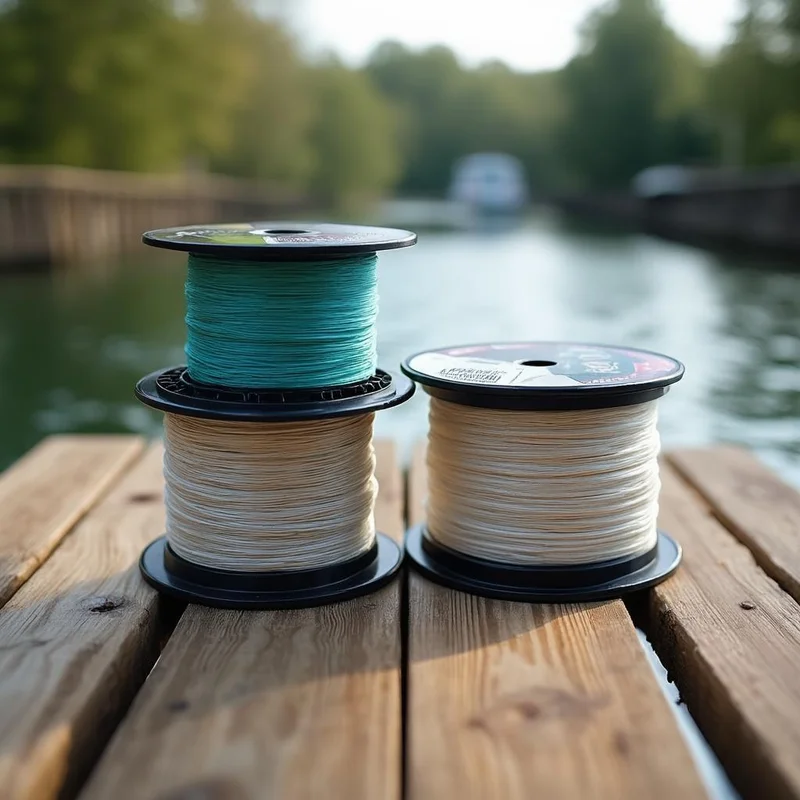
1. What Are You Actually Going to Catch?
Most beginners get this question wrong. Not because they don't know what's in the water, because they buy line for the fish they hope to catch, not the fish they're actually going to catch.
I did it. You'll do it. Every angler does it once. You buy 20-pound line because there's a 10-pound bass in your dreams. Meanwhile, you spend three months catching 8-inch bluegill and wondering why nothing bites.
Match your line to the fish you'll see 90% of the time. Not the trophy. Not the story you'll tell later. The fish that's actually swimming in front of you.
I made this mistake in my twenties too, bought 65-pound braid for a Florida canal because I watched a YouTube video of a guy pulling out a 40-inch snook. I caught zero snook that trip.
I caught three mangrove snapper that wouldn't have cared about 8-pound mono, and the thick braid made casting a small jig feel like throwing a brick on dental floss.
Pound Test by What You'll Actually Catch
- Bluegill, crappie, perch, sunfish: 4-6 lb mono. These fish have small mouths. Light line gets the bait in naturally.
- Trout in streams and small rivers: 4-8 lb mono or fluoro. Trout have excellent vision. 6 lb is the sweet spot for most stocked and wild trout.
- Bass (largemouth and smallmouth): 8-12 lb mono. 8 lb for open water and finesse lures, 12 lb around docks and light cover.
- Walleye, white bass, hybrid stripers: 8-10 lb mono or fluoro. Walleye bite light. You need sensitivity more than strength.
- Catfish under 10 pounds: 12-15 lb mono. Catfish don't care about line visibility. They care about pulling hard.
- Pike and musky: This is not a beginner fish. Come back in a year.
If you fish a pond or small lake and don't know what's in there, start with 8-pound monofilament. It's light enough for panfish and trout, strong enough for bass up to 4-5 pounds.
I've caught more fish on 8-pound mono than every other line weight combined. For the full chart broken down by species, see our species-by-species line guide.
2. How Clear Is Your Water?
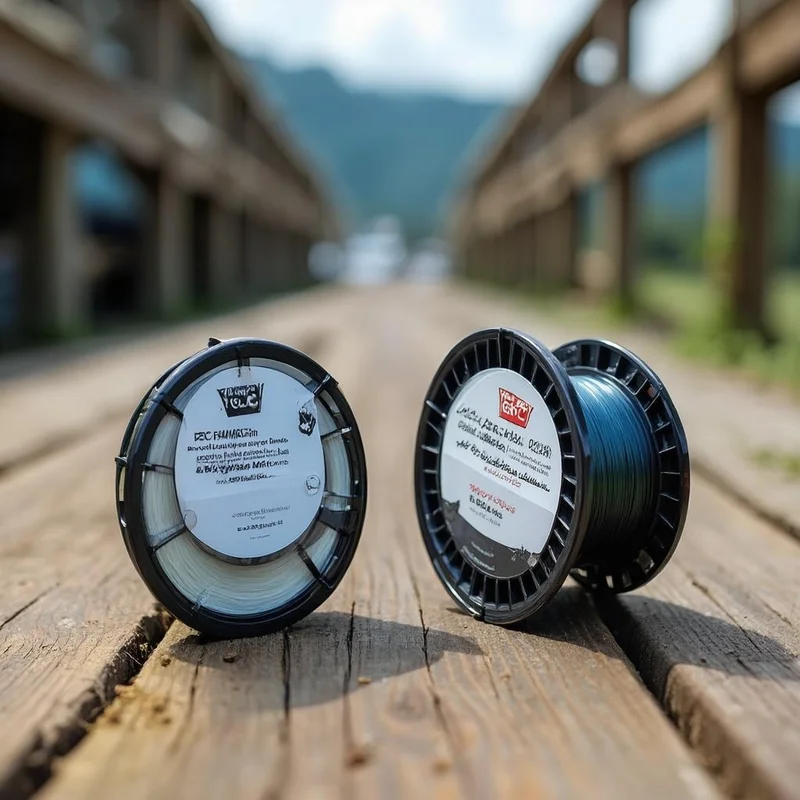
This is the question that matters more than most beginners realize. Fish see line. Not always, not perfectly, but often enough that water clarity should drive half your line decisions.
I tested this accidentally one summer. I was fishing a clear Wisconsin lake with 10-foot visibility, throwing a weightless Senko on 10-pound clear monofilament.
My buddy was next to me using the exact same bait on 15-pound green mono. Same rod. Same retrieve speed. He got skunked. I caught seven bass in three hours.
The difference? His line was thicker and more visible. In water that clear, bass could see it from 4-5 feet away. They'd approach the bait, pause, and turn.
I watched it happen three times before I figured out what was going on.
| Water Condition | Best Line Choice | Pound Test Range |
|---|---|---|
| Gin-clear (visibility 8+ ft) | Fluorocarbon main line or mono + fluoro leader | 4-8 lb |
| Moderately clear (4-8 ft) | Clear monofilament | 6-10 lb |
| Slightly stained (1-4 ft) | Green mono or light braid | 8-15 lb |
| Muddy/chocolate milk | Any line works, visibility doesn't matter | 10-20 lb |
Clear water demands invisibility. That means fluorocarbon, either as your main line or as a 3-5 foot leader tied to mono.
Fluorocarbon refracts light at nearly the same angle as water, which makes it effectively invisible to fish. It's not magic. It's physics.
But fluorocarbon is also stiffer and more expensive. For a beginner fishing moderately clear ponds and lakes, clear monofilament is perfectly adequate.
I landed hundreds of bass on clear Trilene XL before I ever touched a spool of fluorocarbon. Don't let anyone tell you fluoro is mandatory. It's a tool, not a requirement.
Stained or muddy water? Visibility doesn't matter. Fish hunt by vibration and scent in dirty water, not by sight. Use whatever line gives you the strength and handling you want.
For a deeper dive on how water conditions change everything, check our guide on fishing line for stained vs clear water.
3. What's Your Budget, Honestly?
Here's the question most guides won't ask because it's uncomfortable. I'm asking it because wasting money on line you don't need is the most common beginner mistake after buying line that's too heavy.
Let me be blunt. If you have $10 to spend on fishing line, spend $9 on mono and $1 on gas to get to the water. Do not stretch your budget for fluorocarbon.
Do not convince yourself that $30 braid is an "investment." It's not. Not yet.
| Budget | Buy This | Skip This | Why |
|---|---|---|---|
| $6-10 | Berkley Trilene XL 8lb or Stren Original 8lb, 330 yards | Anything labeled "fluorocarbon" or "braid" | Cheap fluoro is a nightmare on spinning reels. Cheap braid frays. Good mono at this price catches fish. |
| $12-18 | Same 8lb mono + a spool of 8lb fluorocarbon for leaders | Straight fluoro main line, too expensive per fill-up | A 4-foot fluoro leader gives you 90% of the invisibility at 30% of the cost. |
| $20-30 | 20 lb braid main line + 10 lb fluoro leader | Premium braid (Super Slick, Sufix 832) | Standard PowerPro at $15-18 is perfectly adequate for a first braid. Premium coatings are for later. |
I have caught tournament-winning bags on $7 mono. I have been skunked on $40 braid. The line does not catch fish , your presentation, your knots, and your decisions catch fish. The line is just the messenger.
One budget mistake I see constantly: beginners who buy expensive line, then hesitate to cut off damaged sections because every foot cost them money. With $7 mono, you cut off 15 feet without thinking twice.
With $30 fluorocarbon, you tell yourself "it's probably fine." It's not fine. That hesitation costs fish. Start cheap. Replace often.
For a head-to-head comparison of what you actually get when you pay more, read cheap vs expensive fishing line, I tested both ends of the price spectrum and the results surprised me.
How to Decide in 2 Minutes: The Framework
You've answered the three questions. Here's how they combine into one decision:
If your water is clear and your budget is under $12: Buy 6-8 lb clear monofilament. Berkley Trilene XL or Stren Original. Fill the spool. Go fishing today.
If your water is clear and your budget is $15-20: Buy 8 lb clear mono for your main line. Add a spool of 8 lb fluorocarbon for a 3-4 foot leader.
Tie them together with a double uni knot. Best of both worlds.
If your water is stained and your budget is under $12: Buy 8-10 lb mono in clear or green. The fish can't see it anyway. Spend the savings on better hooks, hooks matter more than line at this level.
If your water is stained and your budget is $20+: Buy 20 lb braid in green or hi-vis yellow. No leader needed in dirty water. You'll feel every bite and never worry about break-offs.
If you don't know your water clarity yet: Buy 8 lb clear mono. It handles clear creeks and stained ponds equally well. You can't go wrong with the default.
I've made this decision for dozens of friends getting into fishing. Every single one who followed the framework caught fish in their first month.
Every single one who ignored it and bought 30-pound braid "just to be safe" spent weeks wondering why nothing bit.
The beginner fishing line guide has the full equipment breakdown if you want more detail on rods, reels, and accessories. This framework handles the line decision. You handle the fishing.
The Line Types: A Real-World Breakdown (Not What Marketing Says)
I've used all three line types extensively, mono for panfish and casual bass fishing, fluorocarbon for clear-water smallmouth, braid for heavy cover and catfish.
Here's what each one actually does in the hands of a beginner, not what the packaging claims.
Monofilament, Start Here
Monofilament is the default for a reason. It stretches 15-25%, which absorbs the shock of a bad hookset or a surprise run.
It ties knots easily, even the basic improved clinch knot holds well on mono. It costs $6-10 for 330 yards. It floats, so your bobber and topwater lures ride correctly.
The downside: mono degrades in sunlight and absorbs water over time. Change it every 2-3 months of regular use. If the line feels rough when you run it between your fingers, you're overdue.
More detail in our monofilament shelf life guide.
Fluorocarbon, The Stealth Upgrade
Fluorocarbon is nearly invisible underwater. Period. That's its one job, and it does it well. But it's also stiffer, harder to knot, and costs $15-30 per spool.
As a beginner, use fluorocarbon as a leader, a short section tied to the end of your mono main line. Three to four feet is all you need to get the invisibility benefit.
Straight fluorocarbon on a spinning reel is frustrating for beginners. It's stiff enough to jump off the spool in coils on the cast.
It requires wet cinching on every knot, dry cinching burns the line internally and creates weak points.
I've watched beginners fight their fluorocarbon main line for an entire afternoon and catch nothing because they spent more time untangling than fishing. For the full story, read our fluorocarbon guide.
Braided Line, Later
Braid has no stretch, which means you feel every bump and tap. It's also thin, 20-pound braid is the diameter of 6-pound mono. This means more line on your spool and longer casts. Braid lasts years, not months.
The trade-offs are real. Braid is highly visible. In clear water without a leader, fish see it and spook. Braid requires different knots, the Palomar is the minimum. It frays on rocks and zebra mussels.
It costs $18-40 per spool. Because it has zero stretch, you need to learn how to set your drag properly. Too tight, and a hard-charging bass will rip the hook right out of its mouth.
Too loose, and you won't drive the hook home.
Braid is for month three of your fishing journey, not day one. When you're ready for it, our braid vs mono vs fluorocarbon comparison walks through the decision in detail.
Two Spools That Earned Their Place in My Tackle Bag
I've burned through hundreds of spools across all three line types. These are the three I recommend without hesitation for beginners who want to catch fish tomorrow.
Berkley Trilene XL, 8 lb, Clear, ~$6.50 for 330 yards
This is the line I put on every friend's reel when they're learning. The XL stands for "extra limp", less memory means fewer coils jumping off the spool. It casts smoothly on spinning reels.
It ties knots that hold. At $6.50 for a 330-yard spool, you can fill two reels and have line left over for respooling mid-season.
I've caught bass, trout, crappie, bluegill, walleye, and channel catfish on this exact line in 8 lb. It is not fancy. It does not have a marketing department. It catches fish.
Check Price on AmazonSeaguar Red Label Fluorocarbon, 8 lb, ~$14 for 200 yards
When you're ready to add a fluorocarbon leader to your mono setup, start here.
Seaguar Red Label is the budget tier of Seaguar's fluorocarbon line, it's slightly stiffer than their premium InvizX, but for a 3-4 foot leader, stiffness doesn't matter.
You're just putting a clear window between your mono and your bait. At roughly $14 for 200 yards, one spool will make leaders for an entire season.
The knot strength is consistent and the invisibility is identical to fluorocarbon costing twice as much. I've been using Red Label leaders for four seasons.
Check Price on AmazonPowerPro Braided Line, 20 lb, Moss Green, ~$16 for 150 yards
When you've got 2-3 months of fishing under your belt and want to try braid, PowerPro in 20 lb is the standard starting point.
It's widely available, reasonably priced, and the 8-carrier weave holds up better than cheaper 4-carrier braids. The 20 lb test has a diameter comparable to 6 lb mono, so it casts well on spinning reels.
Moss Green blends into stained water. If you're in clear water, add a fluorocarbon leader. If you're in dirty water or heavy cover, fish it straight.
This spool will last you an entire season, braid doesn't degrade like mono.
Check Price on AmazonChoosing Line by the Numbers
When you compare line types side by side, the trade-offs become obvious. Here's the data:
| Feature | Monofilament (8 lb) | Fluorocarbon (8 lb) | Braid (20 lb) |
|---|---|---|---|
| Diameter | 0.28 mm | 0.23 mm | 0.23 mm (≈6 lb mono) |
| Visibility | Moderate | Very low | High |
| Stretch | 15-25% | 5-10% | Near zero |
| Price (per yard) | $0.02 | $0.07 | $0.11 |
| Knot ease | Easy, clinch knot holds | Moderate, wet cinch required | Moderate, Palomar required |
| Spinning reel friendly | Excellent | Fair, stiff, can coil | Good in 20 lb and under |
| Best for beginners | Yes, this is your line | As a leader only | After 2-3 months |
| Replace after | 2-3 months | 1-2 seasons | 1-3 seasons |
The numbers tell a clear story. Monofilament gives up some sensitivity and diameter in exchange for price, ease of use, and forgiveness. That's the right trade-off for someone learning.
Braid and fluorocarbon are better lines in specific situations. They're not better lines for someone who hasn't learned to set drag yet.
FAQ
What's the one line I should buy if I can only buy one?
Berkley Trilene XL in 8-pound clear. It handles panfish, trout, bass, and walleye. It ties easily. It costs under $7.
I've recommended this exact line to more beginners than I can count, and I've never had someone come back and tell me it was the wrong choice.
One spool fills most spinning reels with line left over for refills. If your shop doesn't carry Trilene, Stren Original in 8-pound clear is the backup, slightly stiffer but equally reliable.
Can I just use braided line and skip all this?
You can, and some beginners do. But I've seen more new anglers get frustrated with braid than with mono.
Braid requires different knots, the Palomar is minimum, and not every knot you learned for mono holds in braid. Braid has zero stretch, so every head shake transmits directly to the hook.
If your drag isn't set perfectly, you'll rip hooks out of mouths. Braid is also visible to fish in clear water, which means you need a fluorocarbon leader, adding another knot and complication.
Start with mono. Move to braid when you know why you need it. Check our braided line vs mono comparison for a deeper dive.
Does line color actually matter?
Yes, but only in clear water. In water with 6+ feet of visibility, fish can see thick, dark, or brightly colored line from several feet away. Use clear or low-vis green line in these conditions.
In stained or muddy water (visibility under 2 feet), color doesn't matter at all, fish hunt by vibration and scent, not sight.
High-vis yellow line is useful for detecting subtle bites, but in clear water, always add a clear leader in front of it.
For the full science, read our guide to line color and fish visibility.
How do I know when to replace my line?
Run the last 3-4 feet of line between your thumb and forefinger. If you feel any roughness, flat spots, or bumps, cut that section off and retie.
For monofilament, replace the entire spool every 2-3 months of regular use, or whenever the line looks cloudy or feels stiff. Fluorocarbon lasts 1-2 seasons.
Braid can last 3+ seasons, trim the first 20-30 feet every few trips. A $7 refill spool is cheaper than losing the fish you've been chasing all season.
Our guide on when to replace fishing line covers the warning signs in detail.
Sources & Industry References
- International Game Fish Association (IGFA), Official world record authority and fishing line standards reference
- Wired2Fish, Independent fishing gear reviews and line testing data
- TakeMeFishing.org, Recreational Boating & Fishing Foundation beginner resources and species guides
Still Not Sure Which Line Matches Your Setup?
LineCalc Pro takes your reel size, target species, and fishing conditions and tells you exactly which line to buy. No guessing. No wasted money.
Try LineCalc Pro →As an Amazon Associate, we earn from qualifying purchases. Product prices are approximate as of June 2026.
Frequently Asked Questions
Who is this guide for?
Anglers looking to make informed decisions about fishing line selection , from beginners to experienced fishermen who want to understand the technical details behind line performance.
What's the most common mistake anglers make?
Choosing line based on price alone, or using the same line for every situation. Line diameter, material, and pound test should match your target species, water conditions, and fishing technique.
How often should I replace my fishing line?
Monofilament: every season or after 8-12 trips. Fluorocarbon: every 2 seasons. Braided line: can last 2-3 seasons if properly maintained. Replace immediately if you see fraying, discoloration, or memory coils.
Braid vs Mono vs Fluorocarbon — which should I pick?
Braid for sensitivity, casting distance, and heavy cover. Mono for topwater lures, stretch forgiveness, and budget. Fluorocarbon for clear water, leader material, and abrasion resistance. Most anglers use a combination.
What pound test line should I use?
Match to your target species: 4-8lb for panfish, 8-12lb for bass, 15-30lb for catfish/striper, 30-65lb for musky/saltwater. Check your rod's line rating , it's printed on the blank for a reason.
What should beginners check before buying line?
1) Match line weight to your rod rating. 2) For spinning reels, stick to 8-12lb to avoid wind knots. 3) Don't overspend on your first spool , $8-15 mono is perfectly fine to learn on.